Community opposition to the establishment of data centers in Parker County shouldn’t be dismissed
as uninformed ‘NIMBY-ism.’ Because we choose to stand against them isn’t a rejection of data
centers, but of process and impact — something is being imposed on the community that will directly compete with
us for resources necessary for our survival, such as water and clean air. To have that imposition occur when we
do not have a seat at the table — when monied interests and property rights are given a seat, but the citizens
and human rights are checked at the door — is simply not acceptable.
It is possible that, when all the financial and environmental concerns are addressed and there is evidence of
adherence to a plan that protects the citizens and the environment of Parker County, data centers will simply be
a part of the landscape. But if the process is open and inclusive, we not only have built-in protections for our
community, we have built a collaborative effort across the county, focused on the common good. This is a habit we
must continue, because this will not be the last challenge our community will face.
01 · What just happened
The appraisal district just recognized the conversion
Parker County Appraisal District, May 15, 2026
On May 15 the appraisal district stripped the agricultural exemption from all 18 parcels at 501
Pearson Ranch Road. In plain terms: the county now officially treats this land as an industrial site, not a
ranch — because that is what it is becoming.
The CAD issued corrected notices on all 18 parcels owned by Black Mountain Power LLC at
501 Pearson Ranch Road.
The notices removed the agricultural exemption. The parcels are no longer being valued as
ranchland, because they are no longer being used as ranchland.
This is the appraisal district officially recognizing that the conversion has begun.
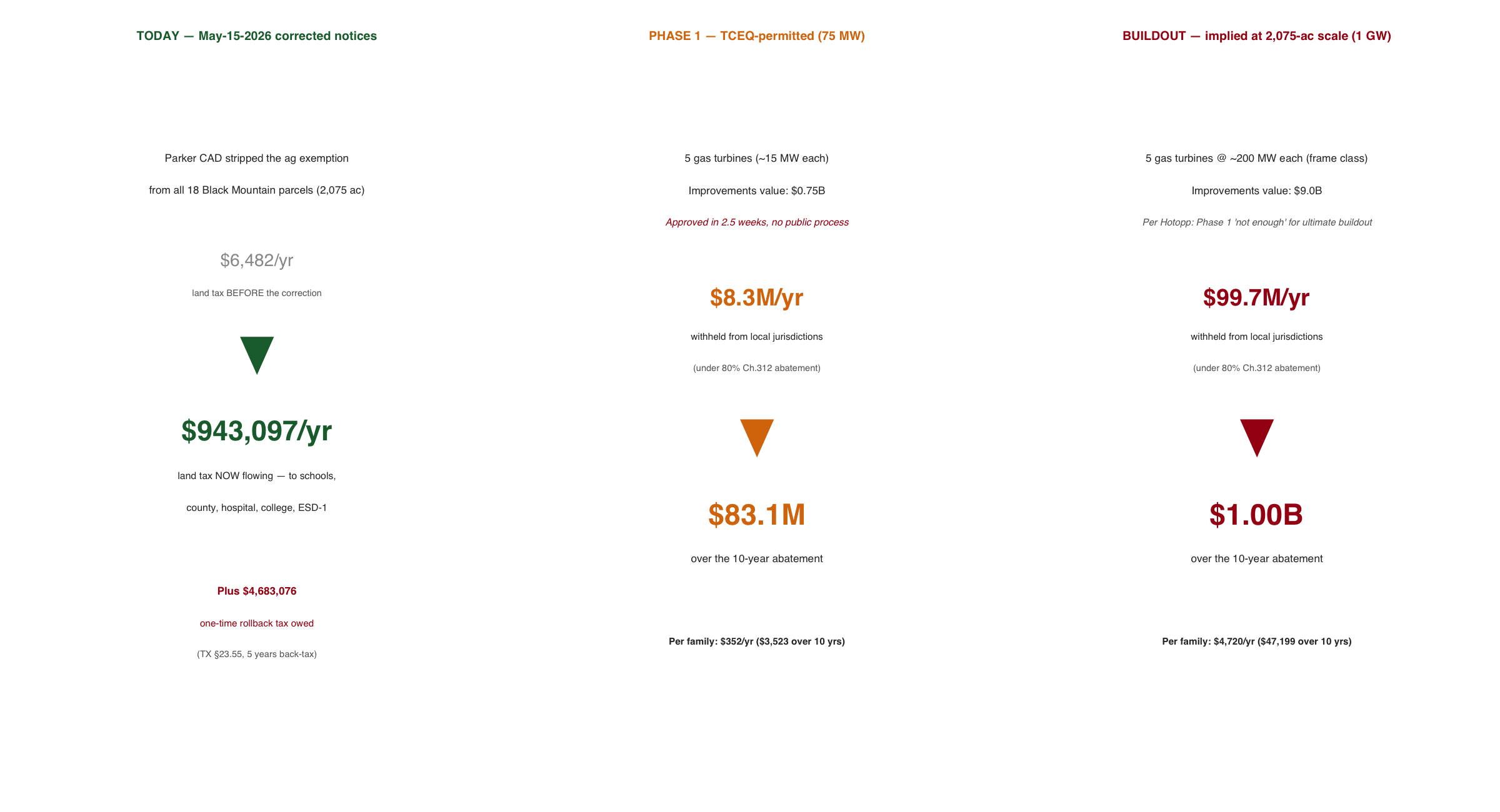
Annual property tax on the 2,075 acres:
$6,482/yr
before the correction (under ag exemption)
$943,097/yr
after the correction
Plus ~$2.81 million one-time rollback tax owed
(TX Tax Code §23.55, amended by HB 1743 in 2019 — 3 years of back-tax, plus 5% statutory interest)
The site was deliberately pulled out of Weatherford's jurisdiction and sits on top of the city's
drinking-water watershed — so the people most affected have the least say over it.
18 parcels · 2,075.28 acres assembled under Black Mountain Power LLC
Taxing units: Weatherford ISD, Parker County, Hospital District, Junior College District, ESD-1, Lateral
Road
Removed from Weatherford's ETJ — petitioned out, so the city has no land-use authority
Inside the Lake Weatherford watershed — the city's drinking-water source
~2 miles from the northern City of Willow Park boundary
~1 mile from a proposed $1.5 billion equine development the city has been planning for
four years
Land value
$58,347,790
total market value across all 18 parcels (Parker CAD 2026)
Earlier transactions
2025-06-03: Black Mountain Land Company LP transferred 172.78 ac to Black Mountain Power
LLC 2025–2026: further parcels assembled under the same operator 2026-05-15: ag exemption stripped from all 18 parcels
Sources: Parker CAD · pg01.parker_property · Weatherford City Manager testimony, May 26, 2026.
03 · The owner
One operator, multiple LLCs, one office
And a documented trail of political giving alongside a 2.5-week permit
The same person controls every entity involved — a land company that holds the dirt and a power
company that holds the air permits — all run out of a single Fort Worth office. Six months before the permit
cleared in 2.5 weeks, that company gave the Governor's campaign half a million dollars.
Rhett M. Bennett is the registered agent for every Black Mountain entity and a named
member of Fort Worth Power Core LLC. All four entities operate from 425 Houston Street, Suite 400,
Fort Worth, TX 76102.
The structure separates the land arm from the power arm. The land arm holds the parcels. The power arm
holds the TCEQ air permits and operates the gas turbines.
"Black Mountain is a power company. They're [an] oil and gas company that has land assets
all over the state."
— Chris Strayer, Parker County EDC Director, on the record at the May 26 commissioners
court session
Entity
TX SOS file
Formed
Black Mountain Land Company LP
0801708440
2012-12-28
Black Mountain Royalty LP
—
(earlier)
Black Mountain Power LLC land arm
0805989692
2025-04-11
Fort Worth Power Core LLC power arm
0805493020
2024-04-03
Registered agent for all entities: Rhett M. Bennett.
Registered agent for the power-arm legal filings: Stubbeman McRae Sealy Laughlin & Browder (Midland TX,
Permian Basin energy counsel).
Documented political activity — and the permit timeline
$500,000 — Black Mountain Power LLC → Texans for Greg Abbott Nov 14, 2025 · Texas Ethics Commission Report #101029815
$46,000 — Rhett Bennett → eight Fort Worth City Council members & the Mayor 2025, during zoning approvals
TCEQ permit #179422 approved in ~2.5 weeks, with no public
process.
Nov 14, 2025 donation → permit approved
May 2026. The sequence is a matter of public record. The conclusion is yours to
draw.
Sources: TX Comptroller franchise-tax registry · TCEQ Central Registry · Texas Ethics Commission
Report #101029815 · Texas Tribune (Jan 15, 2026) · Fort Worth Report. See Sources &
methodology.
04 · The statewide pattern
Parker is one site in a statewide rollout
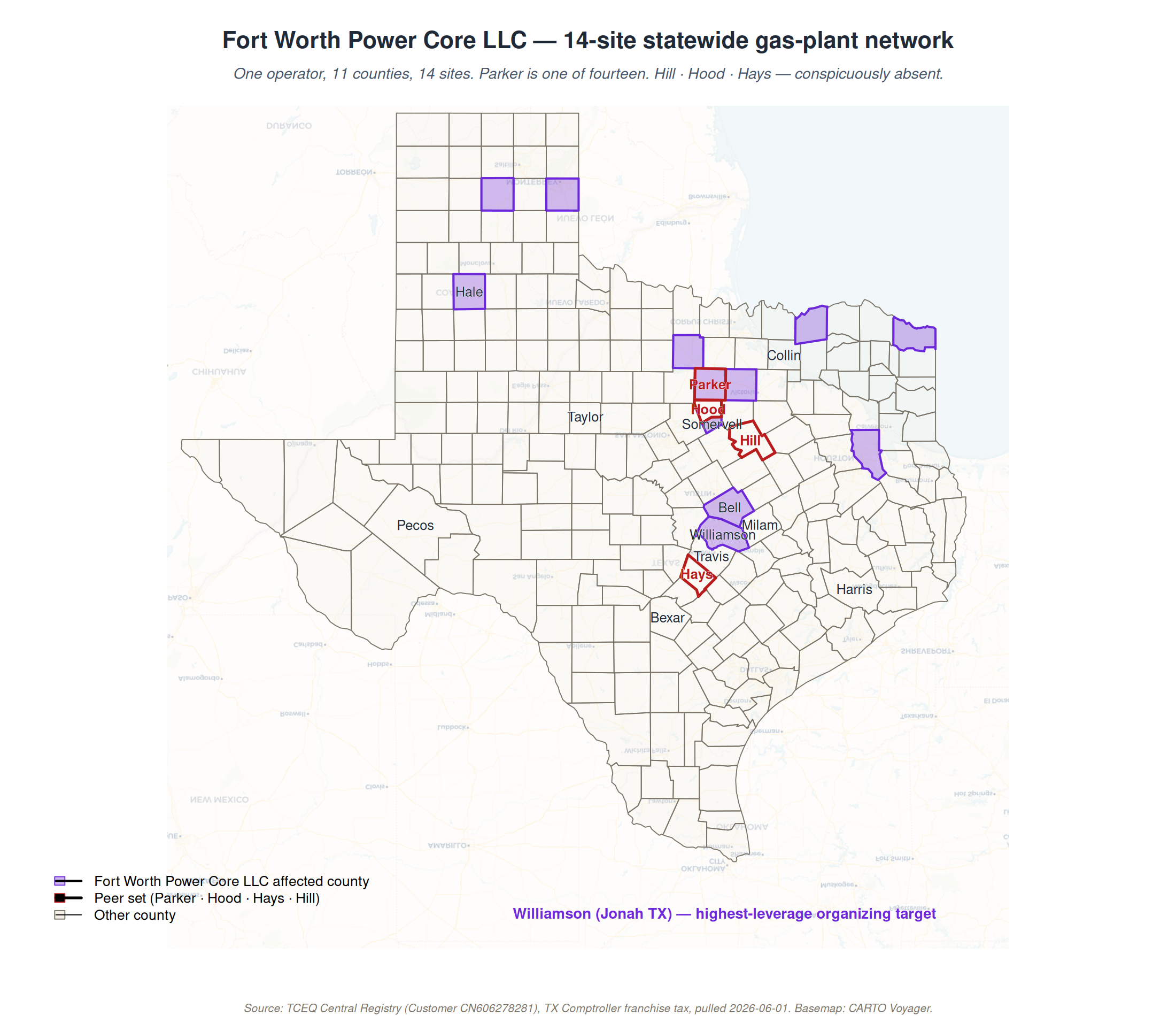
Fort Worth Power Core LLC · 14 sites · ~5,800 MW · 26 months · one address
This isn't a one-off local project. The same operator has registered 14 gas plants across Texas in
just over two years. Four are tied to data centers; the other ten are registered as merchant grid generation,
not tied to a specific data center. Parker drew the developer's attention as the Fort Worth campus ran into
resistance.
14 TCEQ-registered sites across 11 counties. All named "[County] Power Plant." The operating
entity was formed April 2024.
Tier A — data-center power · 4 sites · ~261 MW
Tarrant County ×3 — 186 MW behind-the-meter Powering the $10B Black Mountain campus, SE Fort Worth Parker County ×1 — 75 MW "Backup/bridge power for a new data center" (TCEQ permit language)
Bell · Bowie · Carson · Cherokee · Fannin
Hale · Jack · Somervell · Wheeler · Williamson Selling wholesale power to ERCOT — not tied to a specific data center
2024 Tarrant permits filed. $10B Fort Worth campus planned.
2025 $46K to FW City Council. $500K to Abbott (Nov).
Fort Worth pushes back "Resources
& land use concerns" — campus stalled.
Parker County Rural. No recorded
local contributions. 2.5-week permit. (FW vote still pending: Jun 23)
Sources: TCEQ Central Registry CN606278281 · TCEQ turbine permit database · GEM Wiki · ERCOT
interconnection queue · Fort Worth Report.
05 · The TCEQ permit
A power plant approved in 2.5 weeks, with no public process
75 megawatts · 5 gas turbines · 24/7 continuous operation
Texas has a slow permit path with public hearings, and a fast path with none. This plant took the
fast path — approved in two and a half weeks, with no chance for anyone to comment or object.
TCEQ regulated entity
RN112172408 "PARKER PLANT"
Permit number
Air New Source Registration #179422
Permit type
Standard Permit / Permit-by-Rule fast-track
Status
ACTIVE
Holder
Fort Worth Power Core LLC
Approval timeline
2.5 weeks (vs ~9 months for the City of Weatherford's recent wastewater
permit)
Public-notice process
None
Operating hours
Continuous (24/7)
What "Standard Permit" means
TCEQ has two air-permit paths:
New Source Review (NSR): full technical analysis, 30-day public notice, contested-case
hearing available. Takes 6–18 months.
Standard Permit / Permit-by-Rule: pre-approved authorization templates. Minimal or no
public notice. Takes days to weeks.
The fast-track is legal. But it means the public did not have the opportunity to comment, request a
contested-case hearing, or examine the emissions inventory.
"That permit was approved without any type of public process, which to us was kind of
shocking."
— James Hotopp, Weatherford City Manager, May 26, 2026
Sources: TCEQ Central Registry · May-26-2026 commissioners court transcript.
06 · Cost to the community — Phase 1
Phase 1: about $30 million the county simply never collects
If the county grants an 80% Chapter 312 abatement on what's already permitted
A Chapter 312 abatement excuses the company from county and special-district taxes on most of its
value — so that money is never collected. Unlike the school-district portion, none of it is replaced by
the state: it is revenue for county roads, the sheriff, EMS, the hospital district, and the junior
college that simply never arrives.
The land tax now flows (left). The county-controlled abatement is what's lost — net of any
state backfill. Phase 1 and Buildout shown.
Phase 1 is the 75-MW gas plant plus accompanying data-center capacity TCEQ has already
permitted.
If Parker County and its special districts grant the standard 80% Chapter 312 abatement,
the net local loss — with no state backfill — is:
$3.0M/yr
county + hospital + junior college + ESD + lateral road, every year
$30 million
net local revenue lost over the 10-year abatement (≈ $654 per county household)
The school district's share is separate.
Weatherford ISD can't grant a Chapter 312 abatement; its piece is a state-program (Chapter 313/JETI) matter
and is largely backfilled by the state — so it is not a local loss, and not this court's decision.
We don't count it here.
Net local = county + hospital + junior college + ESD + lateral-road foregone revenue (Chapter
312, no state backfill). Model: parker_costs/RCO_05f_local_net.R. See Sources &
methodology.
07 · Cost to the community — Buildout
Buildout: about $364 million in local revenue, gone
What the 2,075-acre footprint actually supports
The 75 MW is just the start — the City Manager testified it "would not be enough." The land can
hold a campus more than ten times that size. At full buildout, the county and its special districts would give
up roughly $364 million over ten years — about $784 per county household per year — with no
state backfill, and, as the next panel shows, no jobs or product to show for it.
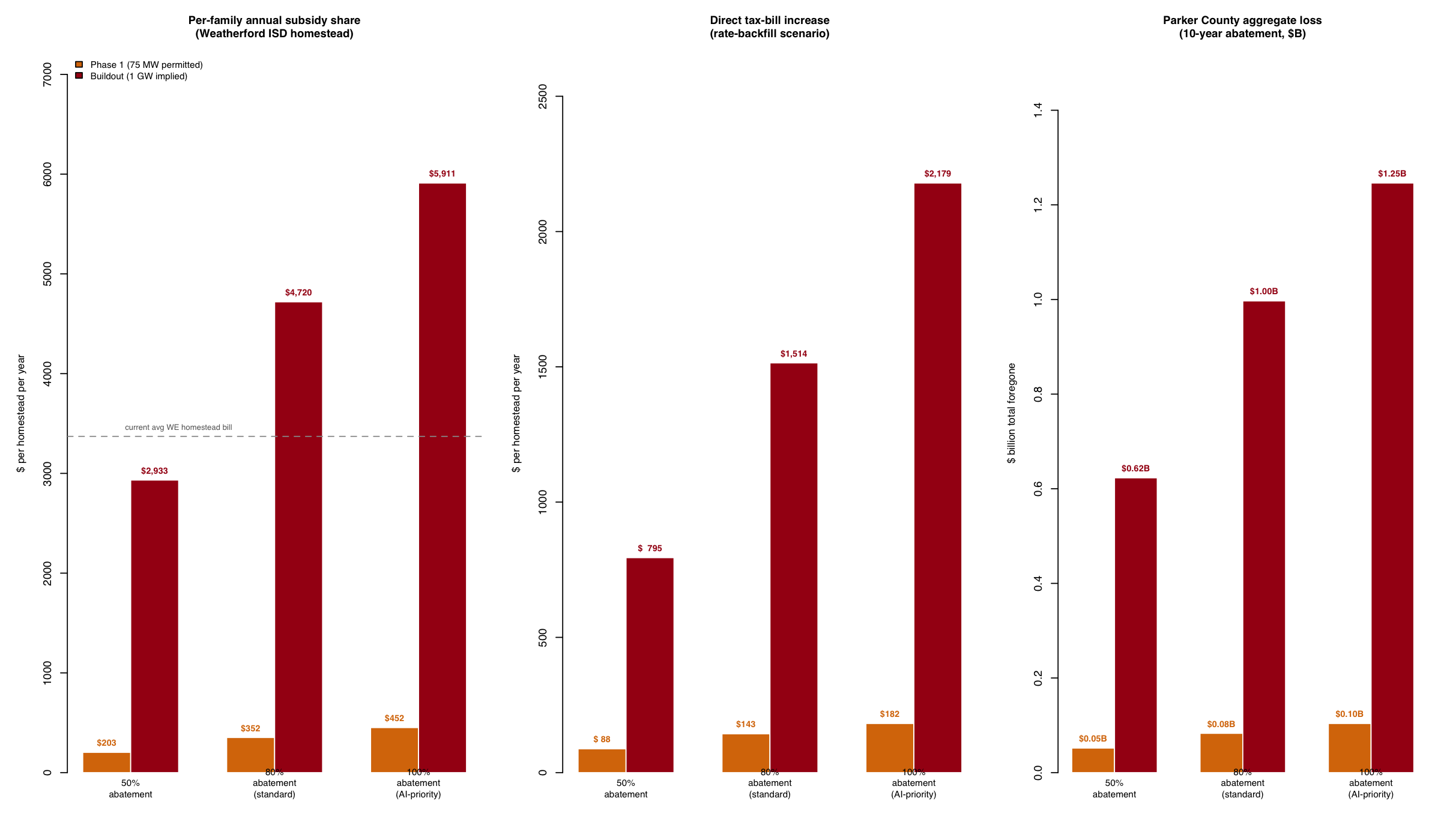
Net local revenue lost (county + special districts, no state backfill) — Phase 1 vs. Buildout,
at 50 / 80 / 100% abatement.
2,075 acres can host a 1-gigawatt campus comfortably. At 1 GW with an 80% Chapter 312
abatement, the net local loss is:
$36.4M/yr
county + hospital + junior college + ESD + lateral road, every year
$364 million
net local revenue lost over the 10-year abatement (≈ $784 per county household per year)
The school-district share (separate, state-backfilled) is
not counted here. Counting only what the county controls and the state does not replace, this is
the real local number.
What comes back to residents: very little. Data centers are
among the lowest-employment developments per dollar invested — Texas's own incentive statutes set permanent-job
floors as low as 10 to 75 positions for projects of this scale, and Black Mountain has filed no
jobs commitment for Parker. The facility's product — power and computing — is sold to customers elsewhere;
residents buy nothing from it. Its 24/7 demand competes for the same water and grid capacity
the community depends on, which tends to raise local costs, not lower them.
Net local = county + special-district foregone revenue (Chapter 312, no state backfill). Capex
assumption: $8M/MW · 85% taxable · 10-yr term. Job floors: TX Tax Code §151.359 / JETI (Gov't Code Ch. 403).
Model: parker_costs/RCO_05f_local_net.R.
08 · Why it can't be made up later
And the county can't simply tax its way back
HB 3 and SB 2 cap how fast local government can raise revenue
It's natural to assume the county could recover this over time by adjusting rates. State law
sharply limits that. An abatement isn't a gap that closes later — it's a lasting reduction in what the county
can fund, even as the project adds new demands to the same budget.
Two laws the Texas Legislature passed in 2019 cap how fast local jurisdictions can raise revenue without
sending it to an election:
HB 3 — limits Weatherford ISD revenue growth without a voter-approval election
SB 2 — caps county and special-district revenue growth at 3.5% without a voter-approval
election
Because of these caps, the county cannot raise its rate enough to recover revenue of this magnitude. In
practical terms the abated amount is permanent — it does not return as a higher bill on
other residents, and it cannot be recouped later.
Two things are true at once
The county cannot recover the foregone
revenue by raising rates — state law caps how fast revenue can grow.
The project still adds real costs to the
existing budget — emergency response for an industrial site, road wear, water-system load, the demands of
growth — while only one-fifth of its value is taxed to offset them.
The gap between what the project costs the county and what
it pays falls on the budget everyone already funds. The specific cost categories and dollar figures
are being compiled.
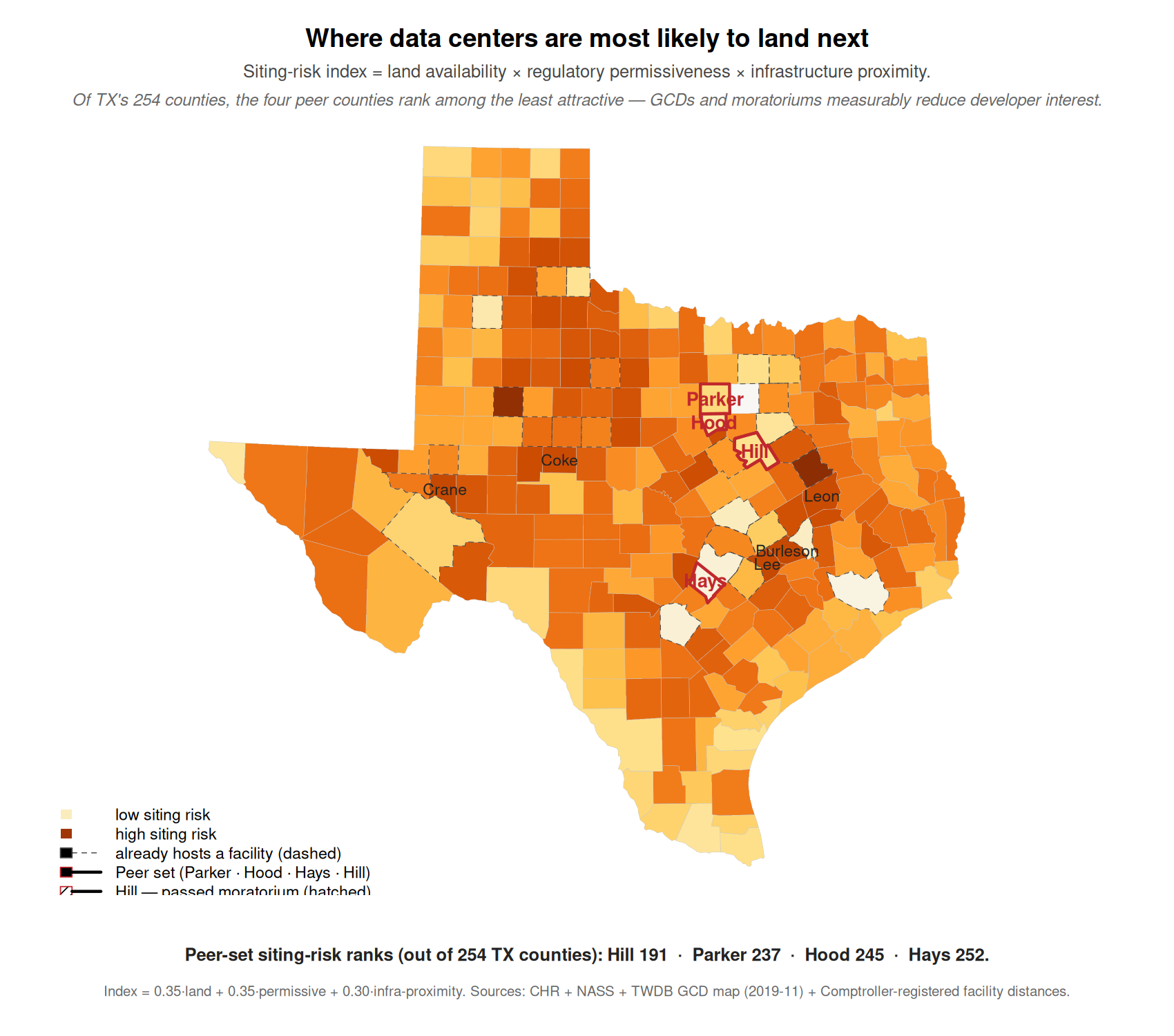
Cheap rural land, light regulation, close to existing infrastructure
Developers pick sites by a simple formula: available land, light regulation, and nearness to power
lines. Parker's own rules already make it a hard target — but the region's infrastructure was attractive enough
that the company decided the local fight was worth it.
Dark red = highest developer attractiveness (land × permissiveness × infrastructure proximity).
Proximity to existing data-center / grid infrastructure
Parker's current rank: 237 of 254 Texas counties.
Our regulations and Hill's moratorium have measurably lowered Parker's score. But the regional clustering
still made us attractive. The developer's calculation was: worth the local political fight here, versus
siting somewhere with less infrastructure.
Hill County (after passing the moratorium): rank 191. Hood: rank 245. Hays: rank 252.
Without the regulations, Parker would be near the top quartile.
Index: 0.35·land + 0.35·permissive + 0.30·infrastructure-proximity. See Sources & methodology.
10 · What other counties are doing
Other Texas counties are already fighting this — and paying for it
And what happened to them is a guide to what works
Parker isn't first. Neighboring counties tried to slow these projects down — and the state and the
developers pushed back hard. Their experience points to where the county actually has power: not land use, but
the tax-abatement vote.
Hood County, TX
Considered a data-center moratorium in early 2026.
State Senator Paul Bettencourt sent a letter to the Texas
Attorney General — explicitly in response to Hood's consideration — alleging counties have no statutory
authority. Hood subsequently denied a plat on local planning grounds. Now in litigation.
Fort Worth Power Core has not pursued Hood, but has a site one county west in
Somervell (Glen Rose).
Hill County, TX
Went further than Hood: actually passed the moratorium. Hired
outside counsel.
Faces the same legal posture from the State — threatened litigation under the
Bettencourt position. Also facing litigation from the data-center developer directly.
Other moratoriums (May 2026)
City of Harlingen, TX (May 25, 2026) Tulsa OK · Denver CO "Several places
in California, Ohio, Wisconsin, North Carolina"
— Sid Miller, TX Ag Commissioner, May 26 testimony
The pattern is national: cities and counties moving to pause or block data-center
siting while state regulations catch up. Texas is at the front edge because of AI buildout pressure.
The key legal fact: Texas counties operate under the Dillon
Rule — limited statutory authority, no home-rule. The county cannot regulate land use
directly. But the court has full statutory authority over tax-abatement decisions.
Sources: May-26-2026 commissioners court transcript · Sid Miller testimony · public moratorium
records.
11 · What this court can do
The court can't block it — but it controls the money
Real authority, within Dillon Rule limits
The county can't stop construction or override the state. But it doesn't have to hand over a tax
break — and that decision is entirely the court's to make. That's the lever.
What the court CAN do
Refuse a Chapter 312 abatement — fully within the court's authority
Refuse a Chapter 381 agreement — same
Adopt a formal policy declining incentives for data-center projects above a threshold
size or absent specified conditions
Direct the EDC to decline data-center incentive task forces
Issue a non-binding resolution articulating the court's policy
File TPIA requests for the TCEQ permit file
Coordinate with the 13 other counties Fort Worth Power Core has sited in
What the court CANNOT do
Block Black Mountain from building on private land (Dillon Rule)
Override TCEQ permitting
Override ERCOT interconnection
Pass an enforceable land-use moratorium (Hill County is finding out the legal cost)
Set city zoning rules (only cities can; data centers are not a permitted use in any Weatherford zoning
district, and the city declined to add them)
The political lever for residents is the abatement
vote. That vote is fully discretionary. Black Mountain has not yet filed for an abatement — but
they will. The window to set policy is now.
Texas Tax Code Chapters 312 and 381 · Texas Constitution Article XI (county powers).
12 · The ask
Six specific actions for the June 9 session
None require new authority — all are within the court's existing powers
Here is the concrete request. Each item is something this court can do on its own, today, without
waiting for the state or a new law.
In fairness to this court: available campaign-finance filings show
no contributions to any member — Judge Deen or Commissioners Conley, Holt, Walden, or Hale —
from Black Mountain, Fort Worth Power Core, or Rhett Bennett. The documented giving went to state and city
officials, not to the county. This request is not an accusation; it asks the court to put on the record a
position more than one member has already voiced.
1. Adopt a formal no-incentive policy today — before any application is filed. Black Mountain
has not yet filed for a Chapter 312 or Chapter 381 abatement. This session is the window. A policy
adopted before an application arrives is legally cleaner and politically stronger than a rejection after the
fact.
2. Use the boilerplate Chapter 381 framework Judge Deen proposed on May 26 as the instrument.
It defines the county's position on data-center incentives going forward and applies to any future applicant,
not just Black Mountain.
3. Direct an inquiry to the 13 other Texas counties Fort Worth Power Core has sited in — Bell,
Bowie, Carson, Cherokee, Fannin, Hale, Jack, Somervell, Tarrant, Wheeler, Williamson. Coordinated pushback is
far stronger than one county acting alone.
4. File a TPIA request for the full TCEQ permit file #179422 — application documents,
correspondence, and whether public-notice requirements were met.
5. No executive sessions on data-center matters. This court committed publicly on May 26 to a
standing agenda item. Today honors that. Every discussion belongs on the public record.
6. Direct the county attorney to send TCEQ a written inquiry on Permit 179422. Parker County is
in the DFW Severe ozone nonattainment area — the NSR major-source threshold here is 25
tons/year of NOx, not 250. The permit was issued on a "backup power" characterization; the City
Manager testified it will run continuously. Those facts conflict. Ask TCEQ: was the correct threshold applied? A
draft letter for the court clerk is available today.
None of these asks require new statutory authority. All are within the court's existing powers.
13 · See for yourself
Don't take my word for it — check the map
Every county, every layer, every source
All of this is built on public data you can examine yourself. The interactive map lets you click
any Texas county and see the numbers behind it.
Toggle the RCO surface — where data-center resource competition is most intense in
Texas
Toggle the MW concentration — where the operating fleet sits today
Toggle the Fort Worth Power Core network — the 14-site rollout
Toggle GCD coverage — where groundwater regulation exists
Fort Worth Report / KERA News — political-contribution records; $10B FW campus stall;
Fort Worth City Council Jun 23 vote
TCEQ turbine permit database (turbine-lst.xlsx) — all 14 FWPC permit numbers, dates,
and MW ratings
GEM Wiki / ERCOT interconnection queue — site-level capacity and grid-connection status
for Tier B sites
Methodology
The cost model takes the taxable improvements (data-center capex + gas turbines
at $8M/MW · 85% taxable share) and applies an 80% Chapter 312 abatement rate. It reports the net
local loss — the foregone revenue of the county, hospital district, junior college, ESD, and
lateral road, which have no state backfill — and divides by Parker County households (46,404). The
Weatherford ISD share is deliberately excluded: school districts cannot grant Chapter 312
abatements, and a school-district value limitation (Chapter 313 / JETI) is largely replaced by state funds
under the Foundation School Program, so it is a state cost, not a net local loss (TEA; Texas Comptroller;
Tax Code §312.002).
HB 3 and SB 2 cap how fast a taxing unit can raise revenue, so the foregone
amount cannot be recovered by raising rates later — it is treated as a permanent reduction in local fiscal
capacity, not as a per-resident charge. The separate question of the costs the project imposes on the
existing budget is being quantified and is not included in the figures above.
The siting-risk index is a weighted composite: 0.35·land + 0.35·permissive +
0.30·infrastructure proximity, normalized to [0,1] across 254 counties.
Show up. Attend every commissioners court session where data centers are on the agenda.
Sign up to speak. Even three minutes of public comment per person, multiplied across thirty residents,
becomes a record.
Share this briefing. The interactive map and this page are open and shareable. Send them to
neighbors. Post on Nextdoor and Facebook with the link.
File TPIA requests. The Texas Public Information Act lets any citizen request records from
any local body. Ask for the air-permit file, the commissioners court video, the EDC task-force materials.
Contact your elected officials. Tell them this matters — and that the abatement vote is the
citizens' lever.
Sen. Phil King · TX Senate District 10 (primary for Parker) ·
senate.texas.gov/member.php?d=10 Sen. Brent Hagenbach · TX Senate District 30 ·
senate.texas.gov/member.php?d=30 Rep. Mike Olcott · TX House District 60 · 212 Santa Fe Dr., Weatherford ·
house.texas.gov/members/member-page/?district=60
Talk to neighbors in the other 13 counties. The Fort Worth Power Core rollout is statewide.
Coordinated pushback is far stronger than one county acting alone.
Thank you. Black Mountain · Parker County · June 9, 2026.
Click image for full detail · click background or press Esc to close